Showing posts with label The Drift Inn. Show all posts

Monday, October 1, 2018

The Yachats Gazette, Issue 85, October 1 2018

Click here for a printable version of Issue 85 (.pdf)

Interview with Gretchen Hetzler

The Yachats Gazette met with Gretchen to discuss the construction and changes on the Drift Inn properties.
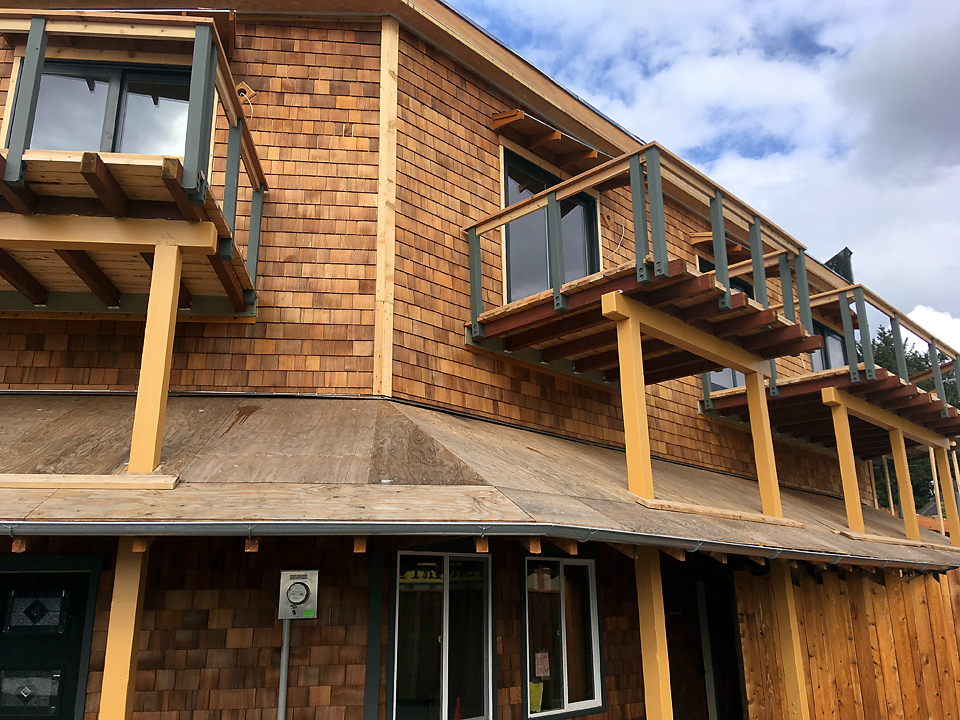
The new Drift Inn building, location of the former laundromat
Gretchen: So, [we have a] new building, which used to be the old laundromat. We decided it wasn't going to be very cost-effective to run a laundromat, because the water costs in Yachats are very high. So upstairs will be four rooms, four individual and unique rooms. Each place has its own bathroom. I think there will be two rooms with a king bed and two rooms with queen beds, and each has a tiled shower and sink. Downstairs, the front entry will be sort of a hang-out space. This is technically a lodging house, so there will be a hang-out space/check-in for guests.

TYG: Are there stairs inside?
Gretchen: There are not stairs inside. It's separate levels. Everything is accessed from the sky bridge for the upper levels. So the downstairs will be this sort of hang-out area with cool art, and couches maybe, and a check-in space. The next room back is a kitchen/laundry facility.

TYG-Editorial Assistant: So the kitchen will be for the guests?
Gretchen: Yes. It might just be a food storage area/kitchenette place, not a full place to cook. It mostly serves as a laundry space, but it will be a kitchen space as well. And then the closest room to us [TYG were sitting in the courtyard off the side of the Drift Inn] is going to be a game room.

TYG: Ooh!
Gretchen: [It will be] for guests and customers alike: we're going to have shuffleboard, foosball, and whatever kind of cool games we can fit in there that make sense and that you can play with.

TYG: Probably too small to have a pool table.
Gretchen: Yes. It is a little too small for a pool table. But we have thought about it, because you know Lester used to have a pool table in here, before we had the place.

TYG-EA: What about a boxing ring?
Gretchen: No, I think that might be a little pushing it. [laughter] There may be some liability.

TYG-EA: It would be very authentic.
Gretchen: And nostalgic, yes. So the back room will be a game room. Currently it's storage for the Mercantile, but we're sussing out some other storage options out back for the Mercantile, because they definitely need it. So we'll have the four rooms, the kind of hang-out area/check-in, laundry/kitchen, and then the game room. And I believe the game room is going to be open to everyone, diners as well as hotel guests. So it's more of a B&B/lodge that we're trying to create, more than like a hotel, because we don't want it to be so impersonal.

TYG: And there are so many hotels in Yachats already. 
Gretchen: We just don't want to create that feeling—we want it to be more of an oasis, a getaway, family-oriented.

TYG: What kind of length do people stay if they're living here?
Gretchen: You know, we've had people stay months at a time. It's not necessarily the most affordable option, but there is that opportunity to do it. We had a gentleman named Art who stayed with us for a long time, over a month and a half, and a woman stay here for over two months, I believe.

TYG: That's awesome!
Gretchen: Yes! It's definitely some people's prerogative to do that. But it's not cheap. [laughs] 

TYG: This is not a place where people would normally stay long-term, or they would rent a house.
Gretchen: Right, but like our "Pedal Out" rooms are $50 a night. It is affordable for some people to do that because it's minimal: you have small rooms, and you don't need a lot. So if you don't need a lot and can manage that, it's not too bad. So all in all, when all's said and done, we'll have twenty rooms.

TYG: Wow! 
Gretchen: Five of those are the hostel-style rooms, the "Pedal Out" rooms. The rest of them vary between more of a typical hotel room to fully-furnished two-bedroom apartments. Like the one above here is called "Eagle's Nest," and it's a fully-furnished two-bedroom apartment. So we have a variety of stuff going on.

TYG: And then of course there is also the sky bridge system itself, which is still pretty new.
Gretchen: I know! It's really cool. The plan is, I believe, [to install] a dumbwaiter or some sort of elevator to get house-keeping supplies up and down and whatever else we deem worthy, I suppose, like house-keeping carts and supplies.

The roof over the Drift Inn patio, as well as a view of the sky bridge.
TYG: Wow, so a big elevator then!
Gretchen: Well, big enough to haul a person and/or things. It's probably going to be electronic. Because I can't imagine a hand-hauled dumbwaiter for that kind of thing. Although if you have enough pulleys, it distributes the work and you don't need it.

TYG: Or a counterweight.
Gretchen: Right.

TYG: That's harder under load, though.
Gretchen: Multiple pulleys would make a little more sense, right. So that's what's going on! We're always working on changing, moving things around.

TYG: Awesome! I'm glad to see you got a safety feature for the fireplace. 
Gretchen: Yes. More than anything, though: It directs the smoke up.

The fireplace with its new hood. In the background, the wood chute.
TYG: I was also quite worried during the summer about having that thing catch fire. It's not so bad now.
Gretchen: Well, the fire department approved our little fire pit. It works out pretty well. We regularly water our plants, so everything's pretty moist. And we've got the driftwood/redwood tables, and they're actually selling pretty well. They're big slabs, and people are actually ordering them. We have extra ones for sale.

TYG-EA: So, this whole patio area, with all the pathways and elevated structures, reminds me of a model railroad layout. 
Gretchen: [laughs] Yes?

TYG-EA: So how did it come about, to turn this into this wonderful multi-level, multi-function sort of Tinker-Toy space?
Gretchen: That's really just a combination of Tom, my step-dad, and my mom's sort of creative mind-workings [Linda Hetzler is Gretchen's mother]. We saw a necessity for handicap accessibility, because so many of our hotel rooms weren't accessible from a wheelchair. So they decided to create this sky way [from the rear parking area to the main upper level of the Drift Inn]. We knew if we did that, a lot more of our rooms would be more easily accessed.

A view of the Drift Inn patio, with the Drift Inn on the left, and the new building on the right.
TYG: To be fair, if I remember right, it was a little bit arduous to get up there because of the steep staircase. 
Gretchen: And that staircase fell apart, so it just moved the process along.

TYG-EA: So was there an early master plan?
Gretchen: No, it's just been a slow evolution. "Okay, this is what we think we want to do next, let's give it a shot and see how it works out." Then the other structure, the one that goes along the back side of the old laundromat building, is metal fabricated at Halco Welding, up in South Beach.

TYG: I can't be the only one to have observed this, but it used to be that the [pipe serving as a wood chute] used to lead directly on top of the wood pile, which meant that any water would run straight under.
Gretchen: However, there are holes drilled into the pipe so that the water goes down a little bit, but it really just goes through, and waters the garden. Tom's very smart like that. He built it then went, "Wait! This is going to need holes."

TYG-EA: At what point did you decide to make this a covered patio?
Gretchen: We had actually thought about it years ago. The shed that's out in the parking lot now, next to the Mercantile, was essentially where that redwood table is now. It's a pretty big shed. So that had to be moved, and a new deck had to be built in order for the deck to be covered, and make it work for the space. We had always intended to do it, but we weren't really sure how we could do it.

TYG: I like how you have all the pieces mixed together—it works really well. As much as you have the pieces slightly not in alignment, it works.  
Gretchen: So all of the redwood slabs and all of the wood except for this pressure-treated wood up here was bought from a local artist wood cabinetry/wood worker guy, who had kept the wood for a long time. He was going to build a pergola, but he just never did. So he sold that to us, then all of the slabs—he had quite a few of those. So it's kind of cool that we—not necessarily recycled, but used wood that was existing.

TYG: And then you've got this, which I've never seen before.
Gretchen: It's a banana tree! And it's thrived since we put it in the pond and moved it a little bit—it's really gone wild. It's really neat. I run into it a lot.

TYG: I've seen banana trees full-grown, or close to it...
Gretchen: Some varieties get very tall, and others don't—we're just going to have to see.

The Publisher and his side-kick. Banana tree is on the right.
TYG: I always wanted to build a house in the woods and leave at least one tree standing in the middle of the living room, and also have an actual stream running through it.
Gretchen: Yes! My husband really wants to build tree houses. I think he'll do that someday. He really has a lot of ideas about tree houses.

TYG-EA: When do you expect this to be done?
Gretchen: Thanksgiving, probably? That would be our ultimate goal, but you never know. Originally we had hoped the outside of the building would be done in August, but then it took a whole other extra month. So now it's mostly just interior work, which is good timing for the weather. So painting, sheetrock, wiring the satellite... We're hoping by Thanksgiving. Alright, I have to get back to work...

TYG: Thank you so much for your time!
Gretchen: Yes! Happy to do it.

Thursday, November 29, 2012

The Yachats Gazette, November 30 2012


Interview with Dr. Stacey Harper

The Yachats Gazette attended a lecture on Nanotechnology by Dr. Harper in October, and was invited to tour her lab at Oregon State University. This is the first part of two installments.

TYG: What is your personal background?
Dr. Harper: So my personal background: I actually was trained as a comparative physiologist. […] I looked at different organisms and studied their physiology, how their bodies work, and how they deal with different stressors in the environment. […] I studied things like: Some animals can live with very very little oxygen, and those same animals can live with lots of oxygen, and they do fine either way. So [what interested me was]: how do they do that? So I studied that for a long time. And then, I got a job with the Environmental Protection Agency, and in that job I did some computer modeling, to try and figure out how to group chemicals based on their structure, to try and predict what they’re going to do and where they’re going to go in their environment. So after two years at the EPA, I realized that I like toxicology a lot, because it’s kind of a mixture of a whole bunch of different fields.

TYG: Yeah, physiology and anatomy all wrapped up in one, because it affects how they work, and it travels through the structures.
Dr. Harper: Exactly. And it’s what happens when something goes wrong and that was really interesting to me. Before I left the EPA, I knew that nanomaterials were going to be something that the EPA were going to be tasked to deal with, but they didn’t have the science or the knowledge to address these newly emerging materials. So that’s why I focused on that when I got to [Oregon State University]. And then, I just stayed! [laughter]

TYG: I remember one time, I was watching, I think, a video by David Attenborough—he’s a very good British BBC reporter—and he was talking about a fish that could breathe air! I forget what it’s called […]. It goes into the reefs in the Caribbean Sea, and it can pursue the mangroves because, when the water starts to run out of oxygen, it can simply go up to the surface and breathe. […] It’s really weird to see fish doing that.
Dr. Harper: Yeah. The little shrimp that I studied looking at the effects of oxygen on them, and how…

TYG: Brine shrimp maybe?
Dr. Harper: No, these are called tadpole shrimp. They’re a cousin to the brine shrimp. But they’ve had the same body structure for the last 180 million years. They’re considered living fossils. […] But I thought their behavior would change, when the oxygen in the water changed, kind of like the fish that go up. But they didn’t do that. They actually have—you know how we have hemoglobin that transports the oxygen through us? We have four sub-units of hemoglobin—they have 29! And, they can mix and match them depending what type of environment they’re in, to make it either grab the oxygen more, or grab it less. So it was really cool, yeah. That was the last thing I looked at.

TYG: What experiments is your team currently running?
Dr. Harper: Let’s wait for that one until we walk through the lab, because I can give you a tour of the lab and I’ll show you all of the different studies we have going on.

TYG: What are the nanomaterials you’re currently testing for oxidation properties? […]
Dr. Harper: So, some of the materials that we’ve tested, and what we’re trying to do in that project, is develop an assay that could allow us to assess the materials for their oxidative potential. […] You can predict then, hopefully, when they go into living systems if they’re going to cause things like oxidative stress, which is a disruption of the oxidative balance in your cells, and your cells are not happy when that happens. […]

TYG: Why is cellulose related to nanoparticles? I mean, I thought it was like a biological material. 
Dr. Harper: It is, but, remember how we define nanomaterials? […] The nano-crystalline cellulose is the basic building block of cellulose, but it’s within that size range. Do you remember the size range [that defines what concerns nanotechnology]?

TYG: 100 to 1 nanometers. 
Dr. Harper: Right! And so if they’re within that range, they’re considered nanoparticles. […] There are a couple of different reasons that we look at nano-crystalline cellulose. One is because they’re going to be a really important nanomaterial for a variety of applications: for building new materials, for strengthening things, for additives to concrete to make it more pliable so it doesn’t break. […] So it’s an important materials class that just hasn’t been studied. That’s one reason why we liked it. But we also liked it because we didn’t think that it was going to be toxic, and so we have a lot of different nanomaterials that we look at it, we think that this surface chemistry, when you stick it on a particle makes it more toxic. So what we wanted to do is to use the nano-crystalline cellulose to test this hypothesis correctly. […]

TYG: Why are zebrafish so important to scientific research? 
Dr. Harper: Ahh. Many many reasons. So they have a lot of investigative tools associated with them, because they’ve long been long been used for developmental biology studies. […] They start with one cell, and within 24 hours they have almost all of their organs formed […] and by five days everything’s fully formed and developed.

TYG: That’s incredible. So you mean these things mature within five days?
Dr. Harper: Yep, and they look just like little, miniature fish.

TYG Ed. Asst.: Speeds up your experiment that way!
Dr. Harper: It does! So it’s rapid throughput, and we can do our exposures in cell culture plates—they’re called 96-well plates—and we can stick one embryo per well so we don’t have to use much nanomaterial, which is important, because you can’t buy big bags of nanomaterials [laughter]; you usually get very little quantities. So they’re very valuable that way. […] And we expose them very early in development because during that early life stage all of the signaling that your cells are going to do for your entire life, all of the genetic molecular signaling that’s going to happen, is both active and necessary for normal development to occur. So if you want to see if this nanoparticle impacts any of the signaling of those signaling pathways, that’s the time to do it.

TYG: I’m just wondering how long these fish live?
Dr. Harper: They sexually mature at 60 days, and they can live for up to 2-3 years. So you can do generational studies if you want to. […]

TYG: […] So that means in fish years, these fish live to about 200 years old! That’s incredible… So I bet they have a lot of babies.
Dr. Harper: They do. They have thousands of babies.

TYG: And they don’t have to do them very fast, because they have such long lifetimes, comparatively.
Dr. Harper: Yep, and they can have babies every single day. So they can lay thousands of eggs every day.

TYG Ed. Asst.: Can I ask a question? What are some of the advantages of dealing with zebrafish as opposed to another well-studied organism; say, Drosophila or E. coli? 
Dr. Harper: Zebrafish are vertebrates, so that gives us a huge advantage. […] And the molecular make-up, the physiology, the cellular anatomy are very similar between zebrafish and humans, mostly because they’re vertebrates. Fruit flies are not. So they have some genes in common, but the zebrafish have way more. I think like 80% of the genes are virtually the same, or have the same type of gene in humans. So when you hit one of those signaling pathways, and you see some kind of malformation comes from that, you can go back and see what signaling molecular pathway did that hit, and do the humans share that pathway, because then it would be a concern for humans. […]

TYG: What is a “Nanomaterial-Biological Interactions Knowledgebase”?
Dr. Harper: Ahh, OK. So, all of this data—so, we’re collecting data in these embryos, right? And we look at 23 to 30 different endpoints to evaluate; so we look at all their malformations, study their behavior, and their development. And, so with all of that information, and with the complexity of just trying to describe a nanomaterial, we had to move to some kind of database/informatics-type system, because my little brain wasn’t able to make the connections. We needed to be able to use some computational tools and some intense mathematics that I can’t do myself. […] But that knowledgebase, we have it as a public resource, so that people in the nanoscience community can look at that and looking at some of the materials that they’re planning on making something out of, and see how toxic they are compared to other materials. […] But with the academic teams that we partner with, and faculty around here that synthesize nanomaterials, we make that publicly available immediately.

TYG: Let’s go into the lab!

[To be continued]

Interview with Richard Sharpless

The Yachats Gazette spoke with Richard Sharpless.

TYG: Where are you from?
Richard: San Gabriel, California.

TYG: Another Californian!
Richard: Well, I haven’t lived in California since 1969. [chuckles]

TYG: When and how and why did you come to Yachats?
Richard: When I was in college, my friend’s aunt had a place on Salmon Street […] and we used to come here, so I knew about Yachats. My mom moved to Yachats, and then she had problems; she was getting old and she needed someone to take care of her, so… I was living in Nashville at the time, and I came out to take care of her.

TYG: I see. What is your background in music?
Richard: Well, let’s see—I used to play accordion. That’s why I know so many polkas.

TYG: So many what?!
Richard: Polkas. It’s oom-pah-pah music. And when I moved to Oregon, I picked up the guitar, and used to carry around a guitar with me wherever I went. And some people thought I was really obnoxious by doing that.

TYG: Obnoxious? Why?!
Richard: Because, when somebody doesn’t know how to play an instrument very well, and they start playing it, it sounds like static. [laughter]

TYG: How many guitars do you have, and what are some of your favorites?
Richard: Uh, five guitars, and each one has a different function…. I’ve got an electric guitar that’s kind of a jazz guitar […] The one I play [at The Drift Inn] is my Martin—and it’s the cheapest Martin they make, it’s a no-big-deal Martin….

TYG: What’s a Martin?
Richard: Martin is a company that’s been around since the early 1800s, and makes guitars. Oh, and then I’ve got an Alvarez-Yairi, which is another guitar similar to the Martin, and it’s a nice guitar in itself. And then I’ve got a resonator guitar, that metal one that I play… and I really like that one too. And two ukuleles.

TYG: [laughter] Do you ever play those out and about?
Richard: Sometimes when I’m with The Bad Weeds, I do…. They’re fun instruments, and they’re really portable. When I was going back and forth to Florence, for a friend of mine, I’d keep a ukulele in the car, and when I’d get stopped with traffic in the construction and stuff, I’d be sitting there playing my ukulele while everybody was getting mad. [laughter]

TYG: Do you play any other instruments, besides the guitar and the ukuleles? Do you still play the accordion?
Richard: Yeah, I play the accordion every once in a while, but I’ve got these long nails that make it really hard to work on the keyboard. I used to play synthesizer….

TYG: What’s a synthesizer?
Richard: It’s an electronic keyboard that has all these different sounds….

TYG: When and where do you usually play?
Richard: Wherever I can. I play at parties, I play at events, I play at the Drift Inn, I just recently played at Ona, I play at the Green Salmon…. And if somebody wants me to play in other places, then I’ll play there too.

TYG: I see. What songs do you usually play at each place, and how do you choose what songs to play?
Richard: I don’t. [laughter] I know a lot of songs… and when I play at the Green Salmon, I have to play songs that I’ve got memorized. When I play at the Drift Inn, I’ll have music in front of me, and I’ll play different things. I know hundreds of songs.…

TYG: Wow….
Richard: Well… that’s what I do. That’s my thang.

TYG: Why do you do what you do?
Richard: Because I can’t do anything else! I can’t repair cars, I can’t build a building, I can’t be a guard, I’m not real good with dogs…. I have a cat; it beats me up all the time.

TYG: Dogs don’t usually beat you up.
Richard: No, no… I mean, I’m good with other people’s dogs, but having a dog of my own—that’s too much responsibility for me.


Interview with Rod Smith

The Yachats Gazette spoke with Rod Smith.

TYG: Where are you from?
Rod: I grew up in California and Colorado. I moved to Yachats after I got out of the Coast Guard in 1981. The Friday the 13th storm was my moving day.

TYG: How and why did you come to Yachats?
Rod: I found Yachats on a motorcycle trip while I was still in the Coast Guard. I had two years left to serve. My folks were looking for a new place to live, so I sent them up here to look, and they liked Yachats, so they moved here, and they opened Captain Nemo’s crab and fish stand, which used to sit where the whale’s tail park is now. My brother, who moved them up, he decided that he wasn’t living there anymore, so he moved up… and he started working at a fish plant. Now he works for the PUD; he lives in Waldport. I finally got to come up here after two years, and that was 1981, … Why did I come to Yachats? Hm…. I’d traveled all over the country on foot, 48 states—and this is the best spot.

TYG: What time of year do you do most of your tree work?
Rod: Different kinds of tree work need to be done at different times of year. We do a lot of our storm-proofing of trees in the fall. We have a lot of damage usually during the wintertime, with weather events. But also, springtime is a big time for all of our orchard work. We go trim people’s orchards and apple trees.

TYG: What’s your best time for trimming trees at private houses?
Rod: Anytime. Anytime is a good time to get a tree away from your house.

TYG: What is your background in tree work?
Rod: I started out working on the power lines, for a private contractor that worked for the PUD [Public Utilities District]. And we trimmed trees over electric [lines]. I was mostly a chipper stuffer then. And then I worked as a private tree worker for many years, and then I became an instructor, and a certified arborist about ten years ago. And I taught at the Job Corps—I started the arboriculture program at Angell Job Corps… and we had four national championship teams there.

TYG [Ed. Asst.]: How does one judge a champion arborist?
Rod: We have jamborees. And the different aspects of tree trimming and tree climbing and safety are all involved. And there are certain events, just like in the Olympics. Like, speed climbing—how fast can you climb a forty-foot rope. And throw-bag, seeing how accurately can you hit with your string and your throw-pouch. There’s an aerial rescue drill, where they have a dummy that’s in a tree, and you have to climb up to the dummy, rescue him, and bring him to the ground safely….

TYG: Isn’t that more of a firefighter’s work?
Rod: Firefighters can’t go where tree climbers go. Their ladders won’t reach, and they don’t have the trucks and equipment. Usually a tree climber is who rescues a tree climber. An ambulance driver or fireman is not going to go a hundred feet up a tree.

TYG: What is your background in working with dogs?
Rod: Oh, I always had dogs when I was a kid. I worked at a dog academy in California, where they taught guard dogs. I was mostly not a trainer then; I was mostly the target.

TYG: Why do you like animals so much?
Rod: I just have a natural affinity for ‘em. They just naturally understand me. I don’t know—that’s a hard question to think about. Hm.

TYG: What other projects are you currently working on?
Rod: Well, I’m trying to set up a Yachats-based security service. It’s going to be called Yachats Executive Security. We’ll be doing homes and business in the area.

TYG: I’m glad that we’ll finally have a sort of […] mini-police department in Yachats.
Rod: Oh, we won’t be the police department; we’ll be a private security firm. […] It takes the sheriff and the security services that are already operating in Yachats a long time to get down here.

TYG: Why do you do what you do?
Rod: I always like new and interesting challenges, and I don’t like doing things that other people do.