Showing posts with label linda hetzler. Show all posts

Monday, October 1, 2018

The Yachats Gazette, Issue 85, October 1 2018

Click here for a printable version of Issue 85 (.pdf)

Interview with Gretchen Hetzler

The Yachats Gazette met with Gretchen to discuss the construction and changes on the Drift Inn properties.

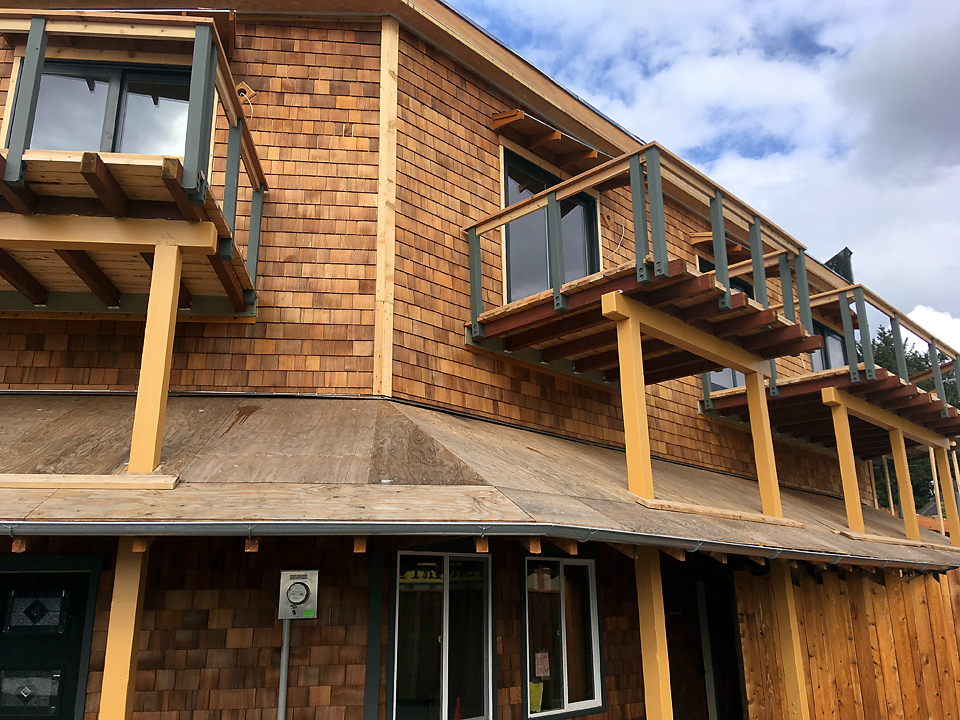
The new Drift Inn building, location of the former laundromat
Gretchen: So, [we have a] new building, which used to be the old laundromat. We decided it wasn't going to be very cost-effective to run a laundromat, because the water costs in Yachats are very high. So upstairs will be four rooms, four individual and unique rooms. Each place has its own bathroom. I think there will be two rooms with a king bed and two rooms with queen beds, and each has a tiled shower and sink. Downstairs, the front entry will be sort of a hang-out space. This is technically a lodging house, so there will be a hang-out space/check-in for guests.

TYG: Are there stairs inside?
Gretchen: There are not stairs inside. It's separate levels. Everything is accessed from the sky bridge for the upper levels. So the downstairs will be this sort of hang-out area with cool art, and couches maybe, and a check-in space. The next room back is a kitchen/laundry facility.

TYG-Editorial Assistant: So the kitchen will be for the guests?
Gretchen: Yes. It might just be a food storage area/kitchenette place, not a full place to cook. It mostly serves as a laundry space, but it will be a kitchen space as well. And then the closest room to us [TYG were sitting in the courtyard off the side of the Drift Inn] is going to be a game room.

TYG: Ooh!
Gretchen: [It will be] for guests and customers alike: we're going to have shuffleboard, foosball, and whatever kind of cool games we can fit in there that make sense and that you can play with.

TYG: Probably too small to have a pool table.
Gretchen: Yes. It is a little too small for a pool table. But we have thought about it, because you know Lester used to have a pool table in here, before we had the place.

TYG-EA: What about a boxing ring?
Gretchen: No, I think that might be a little pushing it. [laughter] There may be some liability.

TYG-EA: It would be very authentic.
Gretchen: And nostalgic, yes. So the back room will be a game room. Currently it's storage for the Mercantile, but we're sussing out some other storage options out back for the Mercantile, because they definitely need it. So we'll have the four rooms, the kind of hang-out area/check-in, laundry/kitchen, and then the game room. And I believe the game room is going to be open to everyone, diners as well as hotel guests. So it's more of a B&B/lodge that we're trying to create, more than like a hotel, because we don't want it to be so impersonal.

TYG: And there are so many hotels in Yachats already. 
Gretchen: We just don't want to create that feeling—we want it to be more of an oasis, a getaway, family-oriented.

TYG: What kind of length do people stay if they're living here?
Gretchen: You know, we've had people stay months at a time. It's not necessarily the most affordable option, but there is that opportunity to do it. We had a gentleman named Art who stayed with us for a long time, over a month and a half, and a woman stay here for over two months, I believe.

TYG: That's awesome!
Gretchen: Yes! It's definitely some people's prerogative to do that. But it's not cheap. [laughs] 

TYG: This is not a place where people would normally stay long-term, or they would rent a house.
Gretchen: Right, but like our "Pedal Out" rooms are $50 a night. It is affordable for some people to do that because it's minimal: you have small rooms, and you don't need a lot. So if you don't need a lot and can manage that, it's not too bad. So all in all, when all's said and done, we'll have twenty rooms.

TYG: Wow! 
Gretchen: Five of those are the hostel-style rooms, the "Pedal Out" rooms. The rest of them vary between more of a typical hotel room to fully-furnished two-bedroom apartments. Like the one above here is called "Eagle's Nest," and it's a fully-furnished two-bedroom apartment. So we have a variety of stuff going on.

TYG: And then of course there is also the sky bridge system itself, which is still pretty new.
Gretchen: I know! It's really cool. The plan is, I believe, [to install] a dumbwaiter or some sort of elevator to get house-keeping supplies up and down and whatever else we deem worthy, I suppose, like house-keeping carts and supplies.

The roof over the Drift Inn patio, as well as a view of the sky bridge.
TYG: Wow, so a big elevator then!
Gretchen: Well, big enough to haul a person and/or things. It's probably going to be electronic. Because I can't imagine a hand-hauled dumbwaiter for that kind of thing. Although if you have enough pulleys, it distributes the work and you don't need it.

TYG: Or a counterweight.
Gretchen: Right.

TYG: That's harder under load, though.
Gretchen: Multiple pulleys would make a little more sense, right. So that's what's going on! We're always working on changing, moving things around.

TYG: Awesome! I'm glad to see you got a safety feature for the fireplace. 
Gretchen: Yes. More than anything, though: It directs the smoke up.

The fireplace with its new hood. In the background, the wood chute.
TYG: I was also quite worried during the summer about having that thing catch fire. It's not so bad now.
Gretchen: Well, the fire department approved our little fire pit. It works out pretty well. We regularly water our plants, so everything's pretty moist. And we've got the driftwood/redwood tables, and they're actually selling pretty well. They're big slabs, and people are actually ordering them. We have extra ones for sale.

TYG-EA: So, this whole patio area, with all the pathways and elevated structures, reminds me of a model railroad layout. 
Gretchen: [laughs] Yes?

TYG-EA: So how did it come about, to turn this into this wonderful multi-level, multi-function sort of Tinker-Toy space?
Gretchen: That's really just a combination of Tom, my step-dad, and my mom's sort of creative mind-workings [Linda Hetzler is Gretchen's mother]. We saw a necessity for handicap accessibility, because so many of our hotel rooms weren't accessible from a wheelchair. So they decided to create this sky way [from the rear parking area to the main upper level of the Drift Inn]. We knew if we did that, a lot more of our rooms would be more easily accessed.

A view of the Drift Inn patio, with the Drift Inn on the left, and the new building on the right.
TYG: To be fair, if I remember right, it was a little bit arduous to get up there because of the steep staircase. 
Gretchen: And that staircase fell apart, so it just moved the process along.

TYG-EA: So was there an early master plan?
Gretchen: No, it's just been a slow evolution. "Okay, this is what we think we want to do next, let's give it a shot and see how it works out." Then the other structure, the one that goes along the back side of the old laundromat building, is metal fabricated at Halco Welding, up in South Beach.

TYG: I can't be the only one to have observed this, but it used to be that the [pipe serving as a wood chute] used to lead directly on top of the wood pile, which meant that any water would run straight under.
Gretchen: However, there are holes drilled into the pipe so that the water goes down a little bit, but it really just goes through, and waters the garden. Tom's very smart like that. He built it then went, "Wait! This is going to need holes."

TYG-EA: At what point did you decide to make this a covered patio?
Gretchen: We had actually thought about it years ago. The shed that's out in the parking lot now, next to the Mercantile, was essentially where that redwood table is now. It's a pretty big shed. So that had to be moved, and a new deck had to be built in order for the deck to be covered, and make it work for the space. We had always intended to do it, but we weren't really sure how we could do it.

TYG: I like how you have all the pieces mixed together—it works really well. As much as you have the pieces slightly not in alignment, it works.  
Gretchen: So all of the redwood slabs and all of the wood except for this pressure-treated wood up here was bought from a local artist wood cabinetry/wood worker guy, who had kept the wood for a long time. He was going to build a pergola, but he just never did. So he sold that to us, then all of the slabs—he had quite a few of those. So it's kind of cool that we—not necessarily recycled, but used wood that was existing.

TYG: And then you've got this, which I've never seen before.
Gretchen: It's a banana tree! And it's thrived since we put it in the pond and moved it a little bit—it's really gone wild. It's really neat. I run into it a lot.

TYG: I've seen banana trees full-grown, or close to it...
Gretchen: Some varieties get very tall, and others don't—we're just going to have to see.

The Publisher and his side-kick. Banana tree is on the right.
TYG: I always wanted to build a house in the woods and leave at least one tree standing in the middle of the living room, and also have an actual stream running through it.
Gretchen: Yes! My husband really wants to build tree houses. I think he'll do that someday. He really has a lot of ideas about tree houses.

TYG-EA: When do you expect this to be done?
Gretchen: Thanksgiving, probably? That would be our ultimate goal, but you never know. Originally we had hoped the outside of the building would be done in August, but then it took a whole other extra month. So now it's mostly just interior work, which is good timing for the weather. So painting, sheetrock, wiring the satellite... We're hoping by Thanksgiving. Alright, I have to get back to work...

TYG: Thank you so much for your time!
Gretchen: Yes! Happy to do it.

Tuesday, September 30, 2014

The Yachats Gazette, Issue 38, October 1 2014

 Click here for a printable edition of The Yachats Gazette, Issue 38

NEW LODGINGS AT THE DRIFT INN

The Yachats Gazette was pleased to speak with Linda Hetzler, owner of the Drift Inn, located on Highway 101 in downtown Yachats.

TYG: Where did you get the idea to build a full-blown hotel?
Linda:
Well, I’ve been thinking about it for a number of years. I actually wanted to buy the old Landmark building and kind of have a interesting, cool, little boutique hotel, because it has really interesting bones and structures and little funny spaces. But it had a lot of problems, and I didn’t have that much money to give to that. So when this fellow that owns the old clinic building wanted to sell me his building, I wasn’t really sure exactly what I was going to do. I looked into shops, [but they] don’t make it around here very well, you know, little stores selling things; people come and go a lot.

TYG: Although the two shops [on this part of the street] are doing really well, though.
Linda:
Yes, the Mercantile does well because I have a lot of things in there. And I have Stacey [Smith], who does a really excellent job.

TYG: And Dark Water seems to be doing pretty well.
Linda:
Yes, and she has an internet, online thing. She’s had the online thing for years.

TYG-Graphic Design: Oh, the Alice in Wonderland store?
Linda:
Yes.

TYG: Together, those two are doing quite well. Pirate’s Bounty Boutique—she moved, but it wasn’t because she wasn’t getting enough business.
TYG-GD: Too much business!
TYG: She needed a bigger space—I think that’s why she moved out.
Linda:
[…] So when I started talking to people about what to do there, some people really liked the hotel idea. I actually tried to open into a hotel over here a few years ago, and the neighbors didn’t really want me to do it and fought it quite strenuously. But this time, when I [made the proposal]—well, it helped that I had a lot for parking.

TYG-GD: You’ve just built a U-turn around that one house?
Linda:
Well, it’s a circular kind of thing.

TYG: Are you going to destroy that one house?
Linda:
Well, in about three years we’ll take the mobile out, and we’ll have it be parking.

TYG: Really, so long?
Linda:
Well, I have an employee that’s living there. It’s hard to find places to live around here that are affordable. It might take a while to get all of the rooms up and going anyway. Because I’m just going to phase them in. I’m not going to just all of a sudden have all those rooms. I have a couple up here [above the Drift], and I’ll put a couple more up there [in the upper story of the other building] maybe in a year or so. In the meantime, we’ll start work on the other building.

TYG-GD: So you’re going to put in rooms, but keep the retail space downstairs?
Linda:
We’ll keep Dark Water, but the other space that’s empty right now, we’re going to turn it into rooms with shared bathrooms.

TYG: Oh, kind of like a youth hostel thing?
Linda:
Well, less expensive [than the other rooms], but still really nice. In fact, I was just talking to these bikers—there are a lot of bicyclists that would like to have that kind of thing.

TYG-GD: Access to showers, but not cost an arm and a leg… and better than camping.
TYG: So how many rooms is your new hotel slated to have?
Linda:
Well, it was approved for 15.

TYG: 15? Not bad!
Linda:
But I might only have 13. And it might take a while to do all 15. I’m just going to see how things go. The empty space [above the other building] that nobody is living in right now, we’re going to divide it in half, and have two spaces available for rent.

TYG: So, I had an idea while I was looking at your parking lot. I was wondering… perhaps you should build rooms above the parking lot.
Linda:
That’s always an option, too! Maybe down the road… You know, all the building I’ve done here: the money that I make I just reinvest. So it takes a while to build up.

TYG: Of course! You wouldn’t do this immediately. Unless you found a fortune! I’m guessing it would be about a $100,000 project.
Linda:
You got it! That’s about right!

TYG: I’m okay at estimating project costs… [laughter] Okay, so, when would you like your hotel to open?
Linda:
Well, we’re actually going to put a sign out front, adjacent to our existing Drift sign—we’re going to have a Vacancy/No Vacancy sign. We have the rooms rented out right now as a vacation rental. So we’re just going to convert those to be part of the hotel. So those are already up and running, and they’ve been booked all the time. We hope to have two more rooms ready to go in by Thanksgiving.

TYG: I’d like to review your hotel sometime by staying the night.
Linda:
There you go! If you wanted to see them, there are people in there right now, but if you came tomorrow I could give you a tour.

TYG: Who do you think will be your target customer group?
Linda:
We’re targeting a broad range of customers. We’re looking at the lower end for the bikers, you know, the people that don’t have a lot of money.

TYG: Yes, that’s what I would do if I opened a hotel. And since I’ve played a lot of online hotel games, a lot of them have targeted customer menus. I generally target most of the customers, or at least as many as I can, so you can have a “Kid’s Free Weekend” or a “50% off Seniors Week.”
Linda:
Oh, I see. That’s a good idea. My friends who are bicyclists have given me some clues about how to target customers in their bracket.

TYG-GD: You have a website, right? Are you going to have a hotel website?
Linda:
Yes. I’m meeting with Lisa Gray on Tuesday. I’m going to revamp my existing website.

TYG: Also, I was thinking with the bicyclists, maybe you could have free bicycle parking or tuning.
Linda:
Well, we’re going to set up a stand for them to put their bikes on, and we’re going to have air available for their tires.

TYG-GD: Oh, that’s a great idea! So who else besides the bicyclists, then? Just a general target? How long do you intend the stays to be?
Linda:
Right now, on these [the vacation rental rooms], we have a two day minimum, because they’re kind of full-blown, with kitchens and everything. I think for the rooms in the other building, right now they’re apartments, and we’re going to keep the kitchens, but we’re going to divide them in half, so the room will just kind of have a balcony and a bedroom, and the ones in the front will kind of be like a studio.

TYG-GD: Personally, I really like the idea of the Drift Inn [coming back to its roots]—it’s been called the Drift Inn forever! Where did that come from?
Linda:
Well, historically it was called that and when I got it I called it “Inn” because that’s how I thought it was spelled, but I came to find out, after many years of having it and some research, that it was “Drift In” with just one “n.”

TYG-GD: That’s funny! So now you’re turning it into the “Inn” with two n’s… that’s awesome!
TYG: I’m guessing I know why they called it that… “Drift” meant the stray pieces of logs, debris… and that would be the people!
Linda: [laughter]
That’s right!

TYG: What I mean by that, is that all groups are welcome!
Linda: [still laughing]
There you go, that’s right! All you who the tide washes ashore, are welcome to drift on in!

TYG-GD: Is there anything else you wanted to tell the community about the hotel and your vision for it?
Linda:
I’m really interested in eclectic kinds of things, and having things be unique. I don’t want to have rooms that all look the same. I used to spend a lot of time in hotels when I was young; it was all very cold and sterile. I like making hotel rooms that are kind of fun, and interesting. I really enjoy science, and I worked in the woods, and so I thought it would be fun for people—especially when it’s raining—for them to have something to do that would be science-oriented. So in one of the rooms I have a microscope, and little slides of different creatures that you can look at, and there are books on all kinds of natural history [subjects]. There are [framed] bugs on the wall… and it’s going to continue to evolve. I had to get it together really quickly so it would be ready for the summer. But the more things I find for people to do while they’re here in the evenings, or when it’s raining…

TYG: What I was thinking is that you could have themes for each room! The Red Room, the Green Room…
Linda:
That’s kind of how it is. The [room] upstairs, I call it Darwin’s Study. And the very top one is more like the Captain’s Room—there are collections of things from all over the world, as if the Captain had been all over, collecting.

TYG: Or you could have the Parlour Room, for example. That would be ultra-luxury room. Or the Transportation Room, maybe. [laughter]
Linda:
That’s right! Trains and boats and motorcycles and cars…

TYG: Yes! Plus, I think if you want kids, you’ll need a playroom or something.
Linda:
Oh yes, most definitely. […] I’ve got five [of these kayaks] that people who rent these rooms can use. If they don’t have racks, I’ve got wheels, and they can walk them over to the beach. […] I’ll maybe get one more that’s a double kayak, so if people have a kid and they don’t want their kid to be in the kayak alone, they can [share it].

TYG-GD: Wow, I had no idea! Are there any other perks for staying at the Drift Inn that we don’t know about?
Linda: [laughter]
Well, I’ll probably be bringing some bikes down, but I haven’t gotten around to it. We’ll have a little shed to put them in and keep them out of the weather.

TYG: You should go to Green Bikes [in Waldport] and get some bikes!
Linda:
You know, I should look into that, because the Green Bike people wanted us to have an outlet here.

TYG: $5 for a perfectly good mountain bike!
Linda:
I know, they’re an amazing resource.

TYG: And there are a lot of local trails around here! And you could have someone host bike tours once a week!
Linda:
Yeah, the problem is just finding somebody to do all this work! There are so many great things that people could do here. So many great businesses that people could start, so many activities that people could participate in… 

TYG: Yes! I think that if you started to make not just a simple hotel, but an amenities hotel—like a resort type of thing—then you’d instantly be in big business.
Linda:
Well the kayaks have been a good draw—people have read about it. But you’re right—it’s really nice to offer people things to do.

TYG: Yes, amenities like a little library/reading room. I think once you get the hotel set up, and rooms above the parking lot, and turn these rooms into amenities, I think you’ll have a lot of money coming in.
Linda:
So, do you think it would be better to do rooms above this parking lot [on the old clinic location] or the other parking lot?

TYG: I think that both could work! Although I think that since the [ex-clinic] parking lot is so much smaller, it could be an amenity thing. The big parking lot up there, once you have the mobile home out of there, then you make that your actual places to stay.
Linda:
Well that sounds good. I hope you include some of your ideas in this article! Because I think those are fabulous ideas! And maybe in a couple of years you can come work for me!

TYG: Maybe, as an architect!
Linda:
Yes! Or be in charge of the amenities, like designing those spaces. […] You know, when we turned Heceta into a bed and breakfast, we had the high school kids. They actually did all of the architectural work for modifying that building.

TYG-GD: Really? Were you part of that?
Linda:
I started it, it was my project.

TYG-GD: So before the Korgans took over?
Linda:
Yes, I hired them. Because it was so successful that I couldn’t do my Forest Service job, and do that, so we hired them.

TYG-GD: When did you stop with the Forest Service?
Linda:
In ’98.

TYG-GD: What were you doing for the Forest Service—were you a Ranger?
Linda:
I did all kinds of things over the years—I worked for them since high school. I built trails and did timber sales, and when I retired I was head of Special Uses. So Heceta was under a Special Use.

TYG-GD: Wow, that’s fascinating!
Linda:
So I already have experience in kind of setting up hotels.

TYG: Well thank you so much!
Linda:
Thank you—it was very good chatting with you!
TYG-GD: I think I’ll call this “Interview with Two Yachats Tycoons”! [laughter all around]

Interview with Max Glenn

The Yachats Gazette was pleased to speak with Max Glenn during a recent early morning interview.

TYG: Shall we get started?
Max:
Sure! I’m ready! Allen, I feel honored to be interviewed by you. I am so amazed at what you have created with the Yachats Gazette. It’s a real contribution to our community!

TYG: Thank you! Where did you live, and what did you do before you came to Yachats?
Max:
Well, Allen, I was born and raised in Oklahoma. I’m a fifth generation farmboy. My grandfather homesteaded in Indian territory in Oklahoma, in Cherokee Strip, in September 1893. They all lined up on the Kansas-Oklahoma border, and they fired a gun at a designated time. My grandpa was a young man; he and some other friends got fast horses. So they went real fast across the border to get there. The best land in Oklahoma is along the northern border. There were sooners, or squatters, they called them, who had come in ahead of time. The further grandpa rode south, past those squatters who were in there early, it got real sandy. He decided he didn’t want that, and came back 10 miles from where he started. There was a man who had more than 160 acres, which they could homestead, and he rode over and said “You’ve got more than 160 acres.” And the man said: “I’ve got a Winchester that says I’m going to keep it.” And Grandpa says: “I’ve got a Winchester”—a gun, rifle—”that says I can have 160 acres, and you can still have your 160 acres.” So I know that my Grandpa wore a white hat. He was a good guy, because Mr. May, this other man, I remember him stealing meat out of my Grandpa’s smokehouse, and then he died in a penitentiary. My sisters and I still have some of Grandpa’s homestead, and my daughter has bought some of that original land too, in Oklahoma.

TYG: Wow, that’s interesting!
Max:
That’s where I came from, I was raised on a farm, I’d never been more than 25 miles from home until I got to show my livestock in the county fair, and district, and state. Then I got to go to the American Royal, in Kansas City.

TYG-Graphic Design: The American Royal?
Max:
It’s a big cattle show. It was awesome. I was a sophomore in high school. One of the kids’ mothers drove us up there. We got into Kansas City at night, and I thought it was the most beautiful thing I’d ever seen: so many lights on the hillside, and all! The next morning, when we woke up, it was the worst slum I’d ever seen! [laughter] But you know, I learned a good lesson while I was there. I had an Angus steer that I showed, and after I showed my steer I was up in the arena watching the show, and there was an old man sitting next to me. He had very little hair, and his skin—you know, when people have been out in the sun a whole bunch it looks like leather?—this old man, his skin looked that way, and the top of his head looked that way. He said, “Sonny, what brought you here?” I told him about my steer, and he expressed a little interest in me. And you know who he was?

TYG: Who?
Max:
He was Mr. J. C. Penney, himself. And JC Penney, in Oklahoma, in the plains, was the first big chain that sold clothes and all different kinds of things—kind of like Fred Meyer’s out here, you know. He was the owner of that. And the lesson I learned from him was that people that have already made it are just as common as me and you. He was just so friendly and so common. It’s the people in life who think they are somebody, and try to impress everybody that aren’t there. If you’ve already made it, you don’t have to worry about impressing people. That was a good lesson for me to learn. [laughter]

TYG: What was life like, where you lived?
Max:
What was life like... Well, it was on the farm, so we lived by the rhythm of nature. We woke up as soon as it was daylight, and I had chores to do: I helped milk cows by hand, and then the crops… The thing that has helped me all of my life was to learn about the rhythm of nature and know that everything is connected. Everything in creation is connected, and I’m just so grateful for all the lessons that I’ve learned in 79 years just being a lot of different places.

Every job that I had, every call that I had for responsibility was always bigger than me. I always wondered, “Why me?” I can look back afterwards, and see that my unique skill set was used in that particular situation. I was going to be an Ag[riculture] teacher—I showed my livestock in state fairs. I had a full scholarship to Oklahoma State University—the other OSU. And it’s orange and black too! [laughter]

TYG: Really? Seriously?
Max:
Yes! I like to fool people, because Marie [his wife] is a Duck, and she has a green Duck hat. So I wear my green Duck hat, and then I have a vest like this that is orange and black, so I wear that and it confuses people. They think I’m a Beaver. [laughter]

TYG: When in reality you’re not a Beaver, you’re a… what’s the name of the Oklahoma team?
Max:
Cowboy! I’m not a Beaver, I’m a Cowboy… [laughter]

But: I had a full scholarship. [pauses] I need to go back and talk about my Grandpas. My Grandpa Glenn, who I told you homesteaded, one of the first things he needed to do was to find a cemetery. They found the highest hill around—it was flat land generally, but there was a little bit of hills—so the highest spot around they made a cemetery, so they could bury their dead.

TYG: Really? That was the first thing they did?
Max:
Well, one of the first things. The first thing he did was build a dugout—my father was born in a dugout, before he built a house. So the dugout was the first thing he built, I’m sure.

TYG: Yeah, really. Because why build a space for the dead before you build for the living?
Max: [laughter]
That’s a good question! Then he got his neighbors together, and they started a church. Grandma fed lots of people—any stranger, or anybody come by, there was this great big long table where everybody would eat. The way he made money was to cut posts. It was along the river, where he could go to get trees—there weren’t a lot of trees around. He would cut trees and make posts, and then haul them in his wagon to sell, so that’s the way he made money. Then he built a house, and he was one of the first ones to build a house! So that was my Grandpa Glenn. And when strangers came to have a meal, when they left, they always knew two things: they knew that he was a Christian, and they knew that he was a yellow dog Democrat.

TYG: Yeah, Democrat in the old sense. Was he a slave owner?
Max:
Oh, no no no no, no slaves.

TYG: Oh, wait, that was 1893. That was way after. I’m sorry, Max!
Max:
And Oklahoma didn’t become a state until 1907. But my other Grandpa, who was the educated one on my mother’s side of the family, he didn’t homestead. He came just after the homestead. He surveyed the land and laid out all the [plats]. He was a surveyor. And he built the first school, and he was the first teacher in that school! My two Grandpas lived half a mile apart, so I would go out and stay on the farm.

TYG: You’re lucky! My closest relative who’s not immediate family lives down in California. And my other Grandma, and my Grandpas, live on the East coast.
Max:
Do you get to go see them?
TYG: Ah, occasionally. One of them I’ve never actually met.

TYG-GD: Max, I wanted to ask you from which country your grandparents came originally.
Max:
Well… I was born on my great-Grandmother’s birthday, and she had a twin brother, and we were born on St. Patrick’s Day! And somewhere I have some pictures of little Max standing, holding a cake with one candle on it, with Grandma Hyatt and Uncle Nate standing behind me. Next year, same picture, there are two candles on the cake, and little Max a little bit taller… Uncle Nate died when I was on my ninth birthday, and Grandma lived to be about a hundred. So… Scotch-Irish. And the reason I was named Max, and not Patrick (because of St. Patrick’s Day), was because my father was a boxing fan and Max Baer was the big champion at the time I was born, in 1935.

I was born in a little town, and my father worked at a gas station and carried gas. Then we moved to a little town nine miles away in a different county, and Dad ran the Co-op station there. We had a farm, but he didn’t move to the farm because he was of draft age, and could be drafted to the army. A lot of farm kids could get deferred from the draft, but he didn’t want to be a “draft dodger,” so he waited until after the war before we moved to the farm.

TYG: Yes, I was thinking that would be World War II.
Max:
World War II. When we moved back to the community that I was born in, I was in the fifth grade when we moved back, and I still remember kids telling me—and it still hurts—that “Our folks told us not to play with you, because you don’t go to our church.” When I was in high school, they were still preaching in German, and it was a German community. My family was not German, they were Irish. What I realize now, later in life, is that it was a very close-knit German community. The parents and the grand-parents went to another little German community, just like it, up in Illinois, near Peoria, Illinois, to choose the mates for their kids. So my classmates didn’t have boyfriend-girlfriend relationships. Their parents and grandparents went and chose the mates for their kids. So I grew up thinking there was something wrong with me, when I couldn’t get a date with these girls. But I look back at it now, and I understand: it was a little religious ghetto, and I was on the outside. There was nothing wrong with me!
So I was a charter member the first year we had vocational agriculture in our high school, my freshman year. Have you heard of Future Farmers of America? That’s a big thing in rural states. I was a charter member of FFA, showed my livestock, became president, and learned a lot of leadership skills in the FFA.

TYG: You became a president of the FFA?
Max:
I was president of my local chapter of the FFA. Then I ran for state vice-president, so I was vice-president of all Oklahoma FFA when I was a senior in high school. And I was also president of all FFA in northwest Oklahoma. We had contests, like parliamentary procedure contests at state level, and we had cattle judging contests, and wheat judging contests, and crop judging contests… I got involved in that. That’s the way I compensated for the little ghetto, and not being part of that, so I could become somebody outside of my community.

TYG-GD: And you’re still participating in boards and leadership and all kinds of stuff, aren’t you! [laughter]
Max:
I asked Marie yesterday […] what I should [talk about during the interview]. She was excited for me […], and she said “Well, you need three elements.” [laughter] “You need three features about your life.” So I wrote these three down:

Number one for me is helping others and inspiring greatness in others. That’s my number one passion.

TYG: That’s a good passion!
Max:
And my second is kind of like it: to support, to mentor, and to empower persons and communities that are marginalized by society, [such as] minorities, and women, and poor people. And the third one is connecting and empowering people to make a difference in our world and in the lives of people around them.

TYG: Those are some great goals!
Max:
So those are my three elements.

TYG: When did you move here?
Max:
We moved here—we bought a house—in July of 2000. We were living in Anniston, Alabama, and my bride Marie was raised in Oregon. She’d been gone for 50 years, and wanted to see if this was still her roots. So we got a campsite at Beachside State Park, for three weeks, and came to see. We weren’t 10 miles out of Portland airport, and I knew this was her roots. She was breathing better, and you could tell. So we bought a house, and moved here from Anniston, Alabama, the next summer.

TYG-GD: Are you glad you did?
Max:
Oh! I’m really glad we did. One of the amazing things is the power of the ocean. I like to tell people… One of my favorite things is to be a volunteer at the Yachats Visitor’s Center; every Friday I have the morning shift. So I tell people: you don’t choose Yachats—Yachats chooses you. […] People here are from many different places, and have done many different things.

TYG: How has life has changed since you came here?
Max:
What I have seen is more and more people being attracted here that connect with the spirit and all of the things of the universe. And I don’t understand it—maybe you’ll be the one to figure it all out! I don’t understand how everything is interconnected, how the Creator made this fantastic thing. I choose to call that Creator “God,” but other people call it “Spirit,” and other people call it other things. But I know there’s a Creator, and I know that there’s a power in the surf that connects all of that. So people are attracted here, that have that awareness and that knowing.

TYG: I think I might know how that connects… It’s what drives life here! Fisheries, salmon catching… it’s what drives life here! That’s why visitors come, that’s what pulls our community together.
Max:
And people love Yachats, and that ties us together. So I guess my response is, to how I’ve seen life change: I’ve seen more and more people identify this core thing about our community, the interconnectedness and awareness of all creation. My friend Karl Evans—he’s the intellectual one—he found the word “Yachats” in Sanskrit writing in 1200, and the meaning of Yachats in that Sanskrit writing was “Where the healers gather.” I know, from my own experience and my own background, that that is the true meaning. So Yachats is where people like your Dad, and others professionally, and others who just understand the connectedness and all of that [gather].

TYG: Although I often feel like I don’t belong.
Max:
Yeah? I know that feeling. But you know, there are people here who have a bigger understanding, and that’s how I see you. You have a bigger understanding of the world and of connectedness. As you interact with people, the way you ask questions, you help them. I saw something in you that was very special, Allen. Remember the night we had the academy presentation, the guy from NOAA [Commander Rick Brennan] was here? And remember the questions you were asking? After your first or second question to him, he knew that you were somebody special!

TYG: And then I got a private tour of his ship!
Max:
And he knew! And I knew, because I’ve been watching you since you were four years old! You have a special place here, and you’re one of those special people.

When I moved here, I asked, “What do I need to know to live in Yachats?” And I was told, “Put your suit and your tie away and save them for your funeral.” [laughter] So you can be talking to somebody at the post office, and it may be a homeless person, and it may a multi-millionaire: you don’t know, and you don’t care. We’re all the same.

TYG: Thank you so much, Max.
Max:
I’m happy to share with you!

Sunday, September 29, 2013

The Yachats Gazette, Issue 26, September 30, 2013

Interview with Stacy Smith, Manager of the Yachats Mercantile

Stacy: I don’t know if you know, that Linda is the owner, and she bought the Mercantile from Ned who had it before.

TYG: But you’re the general, on the ground, manager aren’t you?
Stacy: I guess so yes.

TYG: Because I always think of you as the Mercantile--you and Ned, because Ned was in charge of it for so long.
Stacy: That’s right, he owned it. And then he sold the business to Linda.

TYG: And of course he still works there occasionally.
Stacy: Sometimes he does, although he’s officially retired now. A lot of people are worried about Ned. They come in and they say: “Where’s Ned?” And I say: “It’s all good, he’s okay, he’s just retired.” And then other customers ask about the cat. People miss the cat [Misty]. She went with Wyatt [who took over the mercantile for a period after Ned] and she moved upriver. Before she was just in the Mercantile all the time, she never went out. And now, she’s an indoor outdoor cat. And according to Wyatt, she’s quite happy and very healthy. So people don’t have to worry about her. Although I still do find cat hair every once in a while.
So, Linda took it over, some years and months ago but I don’t know exactly when. I’ve been with the mercantile for a little over a year.

TYG: I think of the Mercantile is having three periods: Ned and Wyatt and then Linda and you. […] Were you working locally prior to this?
Stacy: Before this, I had a cabinet shop in Waldport with my husband [Chris Gramaans]. So we had woodworking in Waldport. We started that in ‘86. We sold it--I can’t remember what year it was, but we had it like 20 years. […] And we had a business before that too.

TYG: So you were working in Waldport—I’m not quite sure whether to call that local or not.
Stacy: I’d call that local.

TYG: Yes, I guess so… 
Stacy: Since I’ve moved here, I’ve worked for the schools—in different positions—and we had our own business, and I homeschooled Milo.

TYG-Graphic Design: What were you doing for the school? 
Stacy: I started out doing records. You know how when the kids transfer, from school to school, I was responsible for making sure that their records followed them. And one of the cool things that I got to do, was to put old records on microfilm. So these were old records from before when they had computers. There were teachers’ records with the names of the kids and their ages, and then there were school records. [The school records] would describe the conditions of the school, and would say things like: Coal level is good this year, or The ventilation in the building is good, there are lots of knotholes. That kind of thing. You know back when they had the one room school buildings. […] They also had a science equipment department that was all a mess, and I cleaned that up and inventoried it. And then I worked with hearing-impaired kids. I went to classes with kids and help them with their work.

TYG-GD: Oh! Do you have sign language?
Stacy: I had a little bit of sign language—intermediate, kind of. I also worked with at-risk kids.

TYG:  “At-risk kids?”
Stacy: “At-risk,” meaning kids who are having trouble. They might drop out, or they were having trouble at home, or they were having trouble at school and it was hard for them to do their work, hard for them to get motivated and come to school. Part of my job was to help them with their work, encourage them to stay in school and to get their diploma. And at one point, I actually did a stint for the Forest Service as a guide up at Cape Perpetua. We did those Fireside Talks.

TYG: You’ve had a very varied career! 
Stacy: [laughter] Yes that’s what a person has to do around here to make it you know!

TYG: What did you want to accomplish with the Mercantile—what do you want to change, what do you want to redesign?
Stacy: I think that we’ve actually accomplished one of the first things that we set out to do, which is increase the number of people coming into the store, because Linda changed it from just being a hardware store into being a Mercantile that sells everything.

TYG: I know! There are two toys stores in Yachats.
Stacy: What’s the other one?

TYG: The Fireside Lodge gift shop.
Stacy: They have toys there?

TYG: Oh yeah, really good children’s toys, like the Klutz model airplane books—the paper airplane book. That’s like the best book.
Stacy: So that touches on something that’s one of my personal goals. And that is that I think the businesses in Yachats would benefit if we all knew what each other had. And I’ve been working hard to try to figure out what other businesses have, and to get other businesses to know what we have.

TYG:  Maybe I should start a blogspot thing—Yachatian Inventory.
Stacy:  That’s not a bad idea! Because I didn’t know that they had toys at the Fireside. […] Do you go there a lot?

TYG:  No, I just visited there and I just learned that.
Stacy: So you’re doing what everybody wishes they could do, and that is to go around to all the places and find out what they have and where the cool stores are. [Another one of our goals] is expanding the inventory that we have.

TYG: You’ve certainly done that! [laughter]
Stacy: When Linda got the Mercantile from Ned, part of it was blocked off. Part of it was just storage, and you weren’t allowed in there. Then Linda took out a wall and opened that space up for inventory. So then we had a garden section added, and a toy section; we have crafts, we have kites, what else did we also add… Fishing has always been there. Clothing [was an addition]…

TYG: Did we already mention gardening? I really like that tractor lawnmower you have in there. 
Stacy: [laughter] Yep, I have a customer who has his eye on that. So we expanded what we had. I think of it as to ways that we serve people: local people, and people who are passing through, visitors. It’s funny how many of those things overlap. People think of the toys as a gift as being something that tourists want.

TYG-GD: No! If I have to bring a gift to a birthday party, I always go to the Mercantile! For example for a 10-11 year old girl, I got a hook and rug kit, and you had everything! The hook, the rug kit, and even the edging for the rug!
Stacy: Yeah, it’s funny. Sometimes we have customers who haven’t been in for a while, and they’re wanting hardware. And they come in and say I don’t want that girly stuff and I say no, we have just as much hardware as when Ned was here, maybe even more!! And it’s fun to watch groups of people come in. There will be some people who are shopping, and they come in because they saw something in the window, and their partner is not interested. They’re not shopping today, because the woman pulled them in because she wanted to look at socks or something. And he comes in the door, and he takes one look, and he says: “Oh!” And he goes over to the hardware section and he’s all into it, and she has to pull him away—and it works the other way too! A couple will come in and there will be one who wants to go over to the hardware section, and the other one says “Oh, this is boring.” and sees something on the other side—you know, people get lost looking on the ceiling! We had a customer in the other day, and here cutting keys for him. And while he was waiting, he was looking along the ceiling, and he and I went over what each of the tools was. He said he used every one of those tools, and he told me what each one was, except for one, which I knew!

I’m trying to think what some of our other goals are—of course, we want to work on our advertising. A lot of people know about us, but not as many people as I would like. I find it embarrassing when a visitor comes to Yachats, and they go in someplace and that place will say “Oh, nobody has any of that!”—and you know there are three places in town that have it. Or when somebody asked me for something, and I can’t tell them where to go, because I don’t know. And I would like it to be where people know what we have. […]

TYG: Why did you decide to switch jobs, and when did you take over at the Mercantile?
Stacy: I was not working at the time, and Linda needed some help. And my husband walked in, and she was talking about feeling overwhelmed, and he said “Well, Stacey is bored at home!” So Linda and I started talking about it. I really respect Linda, and I realized I would like an opportunity to know Linda better, so I thought “Well, I’ll give it a try and see what happens!”

TYG: And of course it worked out beautifully! 
Stacy:  Well yeah of course!

TYG: How do you think you want to enhance [the Mercantile] and make it work better?
Stacy: Well, I think Linda has a brilliant mind for business. Linda has vision, and she doesn’t think about things in the same narrow way that others might—she thinks very creatively. So she had the idea of adding to the business to bring in other people, which I think was brilliant. And I am constantly amazed at how many people come in from other places and say “This is the best little store! I love this little store. I can’t believe you have all this stuff in here! “

TYG: Admittedly, you inherited a lot of the stuff from Ned, like Ned’s organization.
Stacy: Another thing is that Linda is very good at trying things—she’ll try something and if it doesn’t work, it’s no big deal, she doesn’t get mad about it. So she says “Go ahead, give it a try!” For example I ordered new T-shirts, and I guessed, and of course people never want what you have, and we don’t have room for everything. And then I thought that maybe we should have two color choices. And I said what you think Linda? And she says “I have no clue! Let’s give it a try!” And she’s willing to put out the money and give it a try!

TYG:  Where did you come from before Yachats?
Stacy: That’s a long story. I’ve lived here since 1976.

TYG: Cool! The bicentennial anniversary of the United States!
Stacy: Exactly. And on the 4th of July that year, we went down and went smelt fishing with smelt nets. The smelt were coming in like crazy. We moved here from Minnesota.

TYG:  You don’t look like a Minnesotan! You look like an Oregonian.
Stacy: Well thanks! And I think I sound like one now… Our family started in the West and then migrated around. We ended up in Minnesota and my father and my stepmother wanted to move to Oregon. So they came out, the two of them, and went to one of the farms in the Willamette Valley—they thought they could buy an old run-down farm. They didn’t have very much money, and they went looking and looking and looking but they couldn’t find anything. So they thought “We’ll  go over to the coast, we have one day left.” So they came to the coast, and they were driving down the coast, and there was a “For Sale” sign in front of this house. It was a beautiful house with a long sloping roof and there was a cypress tree behind it, and they fell in love with it. So they called my mother (my father and my mother had divorced – they were divorced when I was about five) and said “We have an idea. Would you help us buy this property? And then when we die will give it to all the kids.” So my mother went in on it, so it belonged to my mother and my father and my stepmother. Do you remember Judy Kaufmann? You interviewed her before [in the Farm Tour issue, August 2013], and she sells jams. Her family is related to the Stonefields, [who] were some of the first pioneers in the area. Bray’s Point… the Brays and the Stonefields were some of the first white people in the area to own property. Bray’s Point, which is south of Yachats, almost to Ten Mile, is named after one of the people who homesteaded here. Bray’s Point is the turn right before the straight stretch starting at the Sea Vue. And Stonefield Beach is named after one of the people who homesteaded at the property where I live, George and Mahala Stonefield.

TYG-GD: I thought it was called “Stonefield” because the beach is stony! 
Stacy: That’s what we thought—but no, it’s George Stonefield. And he had the property where we are, and he owned land on both sides of the creek, up to and down, before the bridge was built.

TYG: Then how did he get across?
Stacy: Well, they had a covered bridge just upstream slightly from where the stone bridge is now. And the actual highway—on our property, there is now a driveway, and that’s the old highway. […] Just north of the bridge there’s a pull-out with no signage, and right across from that there’s a field, and that’s our property. Right now my brother Rex, he and his family have a house there, and Chris and I have a house on the hill.

TYG-GD: So you have another brother [besides Ian Smith, with whom Stacey performs]. I don’t think I’ve met Rex.
Stacy: He’s a handyman kind of guy, and an artist—he does sculpture and carves wood, and he does copper. And he paints. He doesn’t do painting very often—he usually adds paint to what he’s doing.

TYG-GD: You guys are an artsy family! Music, and art…
Stacy: Our dad was an artist too—a wood-carver and sculptor.

TYG-GD: Do you and Ian have an official band?
Stacy: We do! Ian and I and Whalen—who also works at the Mercantile—are in a band together. We often play here [at the Drift Inn].

TYG: Was there anything else you wanted to talk about?
Stacy: Well, maybe homeschooling, because it’s good to tell people that there are a lot of people out there—successful people—who homeschool. It helps people who don’t homeschool understand that it’s a valid choice. I homeschooled Milo [Milo Graamans, her son] from beginning to graduation, and we had a great time.

TYG: Really? How did he get a diploma? 
Stacy: He didn’t get one! We just had our own little private party! You don’t have to have a diploma…

TYG-GD: Did he get a GED, or not? 
Stacy: He chose not to get the GED because he could get into the University by taking the SAT, and they accepted him. Some of the universities ask you, and if you say you were homeschooled they ask you different questions and essays. Some schools will ask for a portfolio of work—it depends what kind of school you’re going to. But the U of O [University of Oregon] accepted him based on his SAT scores and his description of what he had done and his involvement. And then he also had to audition.

TYG: I think that’s about it—thank you so much for your time!
Stacy: It was enjoyable—thanks!

Interview with Greg Scott

TYG:  How was your trip to Iceland?
Greg: The trip to Iceland was very good! We spent about two weeks, and most of the time was spent wandering around the island with a guide. We concentrated mostly on the northwest corner and the south coast. That gave us a good opportunity to see the different geology, the different landscapes, the different animals—like birds, and horses, and sheep …

TYG: Really? Horses all the way up there? Sheep, I can see why….
Greg: Yep. Icelandic Horses.

TYG:  Must be pretty hardy. 
Greg: They are... Horses were introduced into Iceland about 800 A.D….

TYG:  That long ago? Probably by the Vikings. 
Greg: The Vikings. And the island was very…  well, things don’t grow there very well, it’s very cold, the winters are very long, and so getting things to grow, living was very hard, especially with volcanoes going off…. But surprisingly enough, most of the eruptions are not that… not as violent, as, say, Mount St. Helens….

TYG:  You know, just the heat of the volcanoes might be a lifesaver for them….
Greg: Well actually, what the heat of the volcanoes ends up doing is melting the glaciers, and causing massive flooding. So when it happens on a glacier, it’s pretty devastating.

TYG:  When it happens on a glacier. But say it happens outside of a glacier….
Greg: Well, it turns out that the volcanoes that are most active are fairly high, and that’s where snow tends to accumulate, so that’s where the glaciers are.

TYG:  What I mean is, say, a less active volcano down lower—it’s still warm, and, like, it doesn’t erupt nearly as often. But it’s still warm…
Greg: When volcanoes go off, they put out a lot of sulfur dioxide, a lot of soot….

TYG:  Yeah. Here’s why that could be a lifesaver: they also put out really, really rich soil.
Greg: Well, it takes thousands of years for that soil to develop. When it first comes out, it’s in the form of rock. Magma.

TYG:  Still—for the less active volcanoes, it’s probably been about a few thousand years since it last erupted.
Greg: Ah, they’re about 20 million years old.

TYG:  So these soils have had plenty of time to accumulate.
Greg: Well, actually, soils are pretty thin.

TYG:  Really? 
Greg: Yeah. When the floods happen, the soils get washed out to sea.

TYG:  I guess so.
Greg: The pictures that I saw of some of the flooding were—devastating. Devastating. All the lighter material gets flushed out first. What’s left is the heavier rock. So—it was a good trip though. I learned a lot.

TYG: How did you become interested in photography? 
Greg: Well, I actually started taking pictures pretty actively in 1969. When I was in Vietnam, I got a camera, actually my first 35mm camera. But in those days, the medium was all film, and so it was more expensive. When digital came out….

TYG:  That was when you really got started?
Greg: Well, actually, I guess a better answer to your question—[it] was when I went to Africa in 1997. That was a big deal, the first time I’d ever been to Africa. I bought a 35mm for that trip—it was still film—and I took a lot of pictures. That’s probably the start of my more recent interest.

TYG:  I see. 
Greg: Photography is a form of creative outlet that marries technology with artistic abilities. So for somebody like me, it’s easier for me to sort of get an in, because I’m interested in the technology of photography, how it works…. I’ve learned, by working with other people, teachers, the artistic side. That was a big part of Iceland—learning composition, how to approach a photographic opportunity.

TYG:  Why did you move to Yachats?
Greg: Um, the simple answer is, we lived in a small town in the valley, and when the population got close to 50,000, we [felt] that the sense of community that comes from living in a small town was gone. You didn’t really know who your neighbors were. […] So we came to Yachats looking for…

TYG:  … The small town feel.
Greg: A sense of community.

TYG:  How did you become a [city councilor]?
Greg: I sat on the Planning Commission for, I think, about four years. That kind of gave me an introduction to the Yachats planning process. After about four years, I felt I was ready to move to a different job. I ran for election, and I’ve been on the City Council now for about… seven years.

TYG:  So how long do you stay on the Council per election?
Greg: Four years.

TYG:  So you’re in your second election term. 
Greg: Correct.

TYG:  How many terms can you have?
Greg: Uh, I don’t know the limit.

TYG:  What do you do as a City Council member?
Greg: That’s actually a pretty good question. Councilors deal with city policy, finances, communications… we’re the conduit to the public, who talk about what’s happening and why. And also pass legislation. So—policy, legislation, finances, communication. That’s chiefly what a councilor does. But there’s another facet that’s maybe not quite so obvious, and that is— I personally believe that every elected official is an ambassador to the community. So—to represent the community to visitors, people who want to know about Yachats—part of our job is essentially to communicate who we are and what we’re all about.

TYG:  I see. Why did you choose to become a City Council member?
Greg: I wanted to make a difference. One of my areas of interest is in transparency in government… to make the work of government more visible to the public. So one of the first things I did on the council was to convince the rest of the council to build a document library. The document library houses all the public documents that the city has issued or collected since the year 2000. So if somebody wants to know what happened in a meeting, or to look up a plan, all the information is in the document library, and it’s up on the web.

TYG:  Is that document library physical, or is it purely on line?
Greg: It’s virtual. The city has all the original documents filed away, but they’re not accessible—they’re stored at the sewer plant. Boxes in a room upstairs.

TYG:  Why do you hang out at the Green Salmon every day they’re open?
Greg: Well, I like the lunches here, and it’s kind of the community living room. The seating is very informal, so people can move around in groups, and you can linger. In a restaurant, there’s a sense that you need to vacate the space and make it available to somebody else, but that’s not true here. And the network is available, there’s power here, you can plug in and work on something….

TYG:  That is, when the power’s ON. [This interview was conducted on a stormy day at the Green Salmon during a power outage.]
Greg: Well, it’s usually on. Very rarely does it go off. The tea’s pretty good. It’s a very friendly place. I mean, why do you come here?

TYG: Primarily it’s for the food, and for the chess.
Greg: Okay, so there you go. It’s not the only place I go—I go to Bread and Roses, I go to the Drift Inn…

TYG: When do you go to Bread and Roses?
Greg: When this place is closed, I go there. Her black bean soup is very, very good. And her breads are very good. My eating interests are fairly narrow.

TYG: Me too. I only eat about twenty total foods.
Greg: Well, you might be a little more narrow than me, then.

TYG: Thank you so much for your time!
Greg: Okay!

Interview with Chuck Hill of Waldport Video

TYG: Why did you open the video store?
Chuck: I saw a need for video rentals as a business and I came to Waldport, and opened a store in 1984.

TYG: What kind of movies you have?
Chuck: I have a wide assortment of movies, I have foreign movies, and specialty movies, and all the popular new ones, and a great bunch of good old ones.

TYG: Where is your store located?
Chuck: Downtown Waldport, on 520 Commercial St.

TYG: When did you acquire your amazing collection of Star Trek movies?
Chuck: I picked those up as they were released to VHS, and then I picked them up as they were released to DVD, no particular date I just don’t remember that far back.

TYG: How does your store operate?
Chuck: I’m open from 10 to 8, every day of the year except Christmas and Thanksgiving.

TYG: Where did you live before Waldport?
Chuck: I lived in a little community called Burnt Woods out on Highway 20. I ran a café there for 10 years and rented movies like everybody else, and somebody bought the business from me and I moved to Waldport.

TYG: What kind of life did you have before you opened the video store? 
Chuck: About the same as here, a “noon to life job”, and I like living that way.

TYG: Do you have any friends or family in Waldport? 
Chuck: There’s Kelly who sometimes helps me here, she has a little family of her own, with kids and a husband. And the lady Jeannette who used to work here but now lives in Bend.

TYG: Anything else you would like to talk about? 
Chuck: Not that I can think of.

TYG-Editorial Assistant: What do like about this business?
Chuck: What I like about this business is keeping people happy by getting them to watch movies, and as you can see I’m an entertainer. I’m a goofball, and [I like] to have fun!

TYG-EA: What do you do when you’re not here?
Chuck: I’m not not here. I live upstairs. I sit and watch movies and make socks while I’m up there.

TYG-EA: Where are you from originally?
Chuck: I was born in New Mexico and was raised in the Seattle area. I have a brother and three sisters.

TYG-EA: What brought you out to this part of the world?
Chuck: Specifically I came to Waldport to open the video store.

TYG-EA: Was there a business here before you that you were able to purchase?
Chuck: I came to town and found a rental space, and bought some VHS movies from a video store, I then went home and had the task of selling my café.

TYG-EA: I get the feeling that this is more than just a place to rent movies for a lot of people in town.
Chuck: It is often been a hangout for different types of people, I used to have a big group of young teenagers, but now all I have is old codgers.

TYG-EA: I think this is kind of a moral center for the community.
Chuck: And I can do that by renting movies, and by just listening.

TYG-EA: It seems like people talk to you.
Chuck: I try to say the right things, but the trickster in me sometimes suggests the wrong things.

TYG-EA: You mentioned what kind of art do you like to do?
Chuck: I like textile art, which is knitting, and fabric, and acrylic paints.

TYG-EA: Where did you get all these statues?
Chuck: People have just brought me those things. I guess it was more important for them to live here than at their house!

TYG-EA: What are some of your favorite movies?
Chuck: Tomorrow, Robert Duvall, and I like all the Star Trek movies.

TYG-EA: How do you keep track of the movies that go out?
Chuck: I’ve placed in alphabetical order so I can find them, and they’re listed on a piece of paper.

TYG-EA: About how many titles do you have?
Chuck: We have about 20,000 titles including VHS’s; VHS’s are three quarters of the total. The reason I don’t have very many DVDs is because it took me 25 years to collect the VHS’s and I haven’t been at the DVD’s as long.

TYG-EA: What is up with all the CHILL paintings?
Chuck: The CHILL is how I sign my name, for Chuck Hill.

TYG-EA: Ah.
Chuck: My father signed his name: BHILL, and everyone started calling him Bill, apparently they didn’t see the H in there. And my family calls me Pat; I don’t like that name. But I didn’t sign my name Bill, I sign Chill, because it’s better.